Tariff Refund Battle Continues: Government Appeals Order
June 17, 2026The US government’s appeal of and motion to amend the Court of International Trade’s (CIT’s) sweeping refund order has introduced a new layer of uncertainty into the process of recovering tariffs imposed under the International Emergency Economic Powers Act (IEEPA). While US Customs and Border Protection (CBP) has begun issuing refunds for many entries through Phase 1 of its newly developed Consolidated Administration and Processing of Entries (CAPE) system, the government’s latest filings suggest that challenges may lie ahead.
Although limited information on the scope of the appeal is currently available, it targets the CIT order to CBP to issue refunds for all affected importers, including those that never filed suit. Based on other contemporaneous filings by the government, it appears that the government takes issue with the universal scope of that order, as well as the relief available for finally liquidated entries for importers without an individual lawsuit. The outcome could determine whether importers must pursue litigation to recover unlawfully collected duties.
For companies seeking refunds, the latest developments underscore the importance of understanding entry liquidation status, preserving rights through multiple avenues where possible, and monitoring the evolving litigation closely.
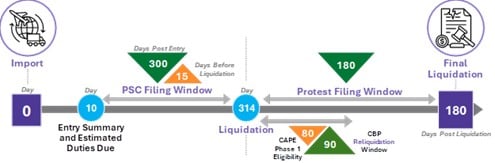
LIQUIDATION TIMELINE
KEY TAKEAWAYS
- The US government has appealed the CIT’s order that CBP refund all IEEPA tariffs, creating renewed uncertainty regarding the scope and timing of IEEPA tariff refunds.
- The government divides entries into three groups: (1) unliquidated and liquidated but not final entries, (2) finally liquidated entries with pending CIT litigation, and (3) finally liquidated entries without pending CIT litigation. Group 3 entries appear to be largely at issue in the appeal.
- CBP’s CAPE refund program remains operational and continues to process refunds for many unliquidated and recently liquidated entries, but important categories of entries remain outside its current scope.
- Importers should closely monitor liquidation and protest deadlines, as preserving administrative remedies may become increasingly important if the government’s position prevails.
- Companies should review their potential refund exposure now and assess whether additional administrative or litigation action may be necessary to protect recovery rights while the appeal proceeds.
BACKGROUND
In February 2026, the US Supreme Court held that IEEPA does not authorize the imposition of tariffs, invalidating a significant category of duties imposed during the prior year. Although the Court resolved the legality of the tariffs themselves, it did not address how refunds should be administered.
In the months that followed, numerous importers filed actions in CIT seeking refunds of IEEPA duties, the majority of which remain stayed. In a series of orders, CIT Judge Richard Eaton concluded that all importers whose entries were subject to the unlawful tariffs were entitled to relief, not only the parties that had filed suit. The court ordered CBP to do the following:
- Liquidate all unliquidated entries without regard to IEEPA duties
- Reliquidate liquidated entries that had not yet become final without regard to IEEPA duties
- Reliquidate liquidated entries that had become final without regard to IEEPA duties
CBP initially argued that immediate compliance was not administratively feasible because existing systems could not process the unprecedented volume of refund claims. The agency subsequently developed CAPE, a dedicated refund mechanism designed to automate and accelerate processing of IEEPA tariff refunds. CAPE is being implemented in phases.
Phase 1 of CAPE became operational on April 20, 2026 and covers most unliquidated entries and certain recently liquidated entries. CBP began issuing refunds through the system in May and has reported processing billions of dollars in refunds. Phase 2 of CAPE will cover entries subject to CBP’s Reconciliation Program and is anticipated to launch at the end of June 2026. Recently, CBP shared that it is preparing the CAPE system for Phase 3 (which will cover finally liquidated entries) and anticipates that it will be ready in late July 2026. However, CBP asserts that it is not currently authorized to process any finally liquidated entries for refunds, so it likely will not go live at that time.
THE GOVERNMENT’S APPEAL
On June 2, 2026, the US Department of Justice (DOJ) formally appealed CIT’s order requiring refunds of all IEEPA tariffs and simultaneously challenged separate orders requiring testimony from the CBP commissioner, which has now been separately resolved. In related filings, the government characterized the refund orders as impermissible universal injunctions and argued that CIT lacks authority to grant relief extending beyond parties before the court.
Although the appeal encompasses the court’s broader refund orders, recent government filings suggest that the principal dispute concerns finally liquidated entries, with the government arguing that importers seeking refunds for finally liquidated entries must pursue importer-specific remedies. However, this position appears to stand in stark contrast with the government’s prior statements to the CIT.
In December 2025, the DOJ represented in a briefing to the CIT that it “will not object to the [CIT] ordering reliquidation of plaintiffs’ entries subject to the challenged IEEPA duties if such duties are found to be unlawful.” AGS Co. Auto. Solutions v. CBP (Slip Op. 25-154) (citing DOJ’s briefing). The DOJ continued, affirmatively stating, “even if future entries are liquidated, defendants do not intend to oppose the [CIT’s] authority to order reliquidation. . . . Such reliquidation would result in a refund of all duties determined to be unlawfully assessed, with interest.”
The critical point, though, is that the DOJ now asserts that any such order must be made on an importer-by-importer basis, rather than universally for all importers that paid the unlawful IEEPA tariffs. However, this position appears inconsistent with the government’s January 2026 concession that it would refund IEEPA tariffs to “all current and future similarly situated plaintiffs” upon a “final and unappealable decision” that the IEEPA tariffs are invalid. The CIT recognized the government’s stipulation in an order issued in AGS later that month, in which it denied AGS’s motion to adopt case management procedures.
If the government’s position ultimately prevails, importers whose entries became finally liquidated may need to demonstrate that they preserved their refund rights through administrative protests or litigation. Those that did not may face substantially greater obstacles in obtaining refunds.
On June 4, 2026, plaintiffs in V.O.S. Solutions, Inc. v. Trump filed a motion for class certification covering all importers that paid IEEPA tariffs and whose entries are not eligible for processing in CAPE Phase 1. The motion also requested an injunction directing the government to expand CAPE to process all refund claims with interest on the basis that the class is entitled to indivisible injunctive relief.
CAPE REFUNDS CONTINUE, BUT UNCERTAINTY REMAINS
The appeal does not halt refund activity. CAPE Phase 1 remains operational and continues to process refunds for eligible entries. According to recent court filings, the agency has accepted submissions covering millions of entries and certified more than $20 billion in refunds and interest for disbursement.
However, important categories of entries remain outside the current scope of CAPE. These include finally liquidated entries, certain reconciliation entries, drawback-related entries, and other categories requiring additional functionality. CBP contemplates later phases of CAPE to address these more complex situations.
The government’s appeal is therefore likely to have its greatest impact on entries that have not yet been processed through existing CAPE functionality.
WHY LIQUIDATION STATUS MATTERS
The distinction between unliquidated, non-final liquidated, and finally liquidated entries has become increasingly important.
Generally, formal entries liquidate within approximately 314 days of entry unless liquidation is extended or suspended. Once liquidation occurs, CBP has 90 days to unilaterally reliquidate an entry, and importers have an overlapping 180 days to file a protest. If no protest is filed within that period, liquidation becomes final.
For purposes of CAPE Phase 1, CBP has taken the position that it is able to process unliquidated entries and those that have liquidated within 80 days (allowing for an apparent 10-day buffer window from the ordinary CBP action window).
Historically, final liquidation has served as a significant jurisdictional and procedural barrier in customs litigation. Although CIT’s refund orders sought to overcome that barrier by directing relief for all affected entries, the government’s appeal squarely challenges that approach.
As a result, importers approaching protest deadlines should carefully evaluate whether additional administrative action may be necessary to preserve potential refund rights while the litigation proceeds.
PRACTICAL CONSIDERATIONS FOR IMPORTERS
While the appeal moves forward, importers may wish to consider several practical steps:
- Review entry status: Importers should identify which entries remain unliquidated, which are liquidated but still within protest periods, and which have become finally liquidated
- Evaluate protest deadlines: For entries approaching the expiration of the 180-day protest period, importers should assess whether filing a protest may be appropriate to preserve available remedies
- Monitor CAPE eligibility: Companies should determine whether their entries are eligible for current CAPE processing and ensure they have completed any required administrative steps
- Assess litigation strategy: For significant refund exposures involving finally liquidated entries, importers should consider whether litigation may be necessary depending on how the appeal develops
- Coordinate trade and financial planning: Refund timing remains uncertain. Businesses should account for continued delays in forecasting, liquidity planning, and financial reporting
LOOKING AHEAD
The appeal will proceed before the US Court of Appeals for the Federal Circuit, with briefing likely to extend over several months. Although the court could expedite review given the significance of the issues and the volume of refunds at stake, a final resolution may not arrive quickly.
In the meantime, CBP’s refund efforts continue, but the government's challenge has created renewed uncertainty regarding the treatment of finally liquidated entries and the availability of relief for importers that did not file suit.
The next phase of the litigation may ultimately determine whether the Supreme Court’s invalidation of the IEEPA tariffs translates into universal refunds or a more limited recovery framework that depends on procedural preservation and importer-specific claims.
Contacts
If you have any questions or would like more information on the issues discussed in this LawFlash, please contact any of the following: