Federal Circuit Narrows Design Patent Scope Based on Functional Considerations
February 05, 2026In a recent case, the US Court of Appeals for the Federal Circuit affirmed a district court’s grant of summary judgment of non-infringement of a design patent, signaling heightened scrutiny of functional features in design patent infringement analyses. The Federal Circuit addressed how courts should account for functional aspects of a claimed design when applying the ordinary observer test. However, a dissent from the chief judge underscores that there is a lack of consensus at the court regarding the proper treatment of functional considerations in design patent cases.
BACKGROUND
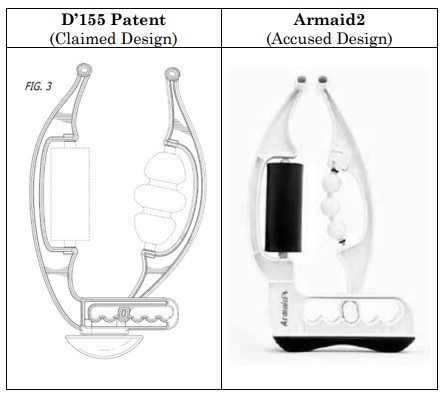
Range of Motion Products LLC asserted US Design Patent No. D802,155, which claims the ornamental design for a body-massaging apparatus, against Armaid Company Inc., alleging that Armaid’s “Armaid2” product infringed the patent. The US District Court for the District of Maine granted summary judgment in favor of Armaid, concluding that no reasonable jury could find infringement, and Range of Motion appealed.
THE FEDERAL CIRCUIT’S DECISION
In a majority opinion authored by Judge Tiffany Cunningham and joined by Judge Todd Hughes, in Range of Motion Products LLC v. Armaid Co., No. 23-2427 (Fed. Cir. Feb. 2, 2026), the Federal Circuit affirmed.
Claim Construction and Functional Elements
The court agreed with the district court’s approach to claim construction, which involved identifying and discounting aspects of the claimed design dictated by function. The majority reiterated that design patents protect only ornamental features, and that courts must distinguish those features from functional aspects before conducting the infringement analysis.
The court rejected Range of Motion’s argument that the intrinsic drawings alone established the ornamental nature of certain design features, concluding that structural elements such as the configuration of the arms and base served primarily functional purposes and therefore could not meaningfully contribute to an infringement finding.
Application of the Ordinary Observer Test
Applying the ordinary observer test, the majority held that, after factoring out functional elements, the remaining ornamental aspects of the claimed design and the accused product were so dissimilar that no reasonable jury could find infringement. Although infringement is generally a question of fact, the court emphasized that under the Federal Circuit’s 2008 decision in Egyptian Goddess v. Swisa and other precedent, summary judgment is appropriate where the protected ornamental features and accused design are “plainly dissimilar” and “sufficiently distinct.”
The majority further cautioned against reliance on broad side-by-side visual comparisons untethered from proper claim construction, explaining that such an approach risks impermissibly expanding design patent protection beyond its statutory scope.
The Dissent
Chief Judge Kimberly Moore dissented, criticizing the majority for placing undue emphasis on claim construction and functional exclusions at the summary judgment stage. In her view, the majority improperly dissected the claimed design and discounted similarities that an ordinary observer would consider significant.
The dissent emphasized that the ordinary observer test is intended to capture the overall visual impression of the design as perceived by consumers, rather than focusing on element-by-element differences. Chief Judge Moore further stated that the Federal Circuit’s 2008 Egyptian Goddess decision “meaningfully changed” the analytical framework from asking whether two designs are “substantially similar in overall appearance” to whether they are “sufficiently distinct” or “plainly dissimilar,” a shift she viewed as inconsistent with the US Supreme Court’s articulation of the test in Gorham Co. v. White. Applying her approach, Chief Judge Moore would have allowed the case to proceed to a jury, as a reasonable factfinder could determine that the designs were substantially similar.
PRACTICAL IMPLICATIONS
This decision has several practical implications for companies that rely on design patents to protect product aesthetics:
- Increased scrutiny of functional features. Companies should expect courts to closely examine whether asserted design elements are driven by function, particularly in products in which utility and appearance are closely intertwined.
- Greater importance of prosecution strategy. Thoughtful claim drafting and careful use of broken lines to provide clear differentiation of ornamental features from more functional aspects may help preserve enforceable scope.
- Early resolution opportunities for accused infringers. The decision reinforces that summary judgment remains a viable pathway where functional elements dominate the claimed design or where remaining ornamental features are plainly dissimilar.
- Continued uncertainty in design patent enforcement. The dissent from the Chief Judge highlights ongoing disagreement within the Federal Circuit over application of the ordinary observer test, suggesting that outcomes may remain panel-dependent absent further guidance from the court or the Supreme Court.
Contacts
If you have any questions or would like more information on the issues discussed in this LawFlash, please contact any of the following: