Judges Criticize Ninth Circuit’s Copyright Infringement Test in Concurring Opinions Post–Kat Von D Verdict
February 09, 2026The US Court of Appeals for the Ninth Circuit has affirmed the district court’s judgment in Sedlik v. Von Drachenberg, a closely watched copyright infringement case involving famed tattoo artist Kat Von D and a photograph of jazz legend Miles Davis. The decision relied on the Ninth Circuit’s unique “intrinsic test” for substantial similarity and, while the court left that test intact, two concurring opinions sharply criticize the doctrine and called for reform—signaling potential future change while preserving the status quo for now.
Jeffrey B. Sedlik, a professional photographer, created and registered a distinctive photograph of Miles Davis in 1989, employing deliberate creative choices relating to pose, lighting, composition, and expression. In 2017, Kat Von D, a well-known tattoo artist, used Sedlik’s photograph as a reference to produce a tattoo for a client and posted related sketches and images on social media.
The tattooing process involved tracing the photograph to create a stencil, followed by extensive freehand shading. Sedlik filed suit against Von Drachenberg, Kat Von D, Inc., and High Voltage Tattoo, Inc., alleging copyright infringement based on the tattoo itself, a sketch, and several social media posts incorporating or depicting the image.

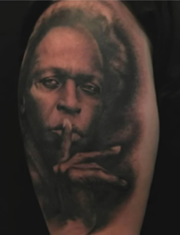
Sedlik’s photograph of Miles Davis (left) and Kat Von D’s tattoo based on the photograph (right). (Source)
Following trial, the jury found that six works—the tattoo, the sketch, and four social media posts—were not substantially similar to Sedlik’s photograph. Von Drachenberg stipulated that four additional “Process Images,” which depicted the tattooing process and included direct reproductions of the photograph, were substantially similar. However, the jury concluded that those images constituted fair use and were therefore not infringing.
Sedlik moved for summary judgment and later for judgment as a matter of law under Federal Rule of Civil Procedure 50(b). The district court denied both motions, and Sedlik appealed.
THE NINTH CIRCUIT’S DECISION AND ANALYSIS
On January 2, 2026, the Ninth Circuit affirmed the district court’s judgment,[1] holding that the denial of Sedlik’s summary judgment motion was not reviewable because it did not present a purely legal question independent of disputed facts. The court further held that the district court properly denied Sedlik’s Rule 50(b) motion since Sedlik failed to show that the jury’s verdict was contrary to the only reasonable conclusion permitted by the evidence under the relevant tests for substantial similarity.
Central to the court’s analysis is the Ninth Circuit’s two-part substantial similarity test: the “extrinsic test,” which assesses objective similarities of protectable elements, and the “intrinsic test,” which asks whether an ordinary reasonable observer would regard the works as substantially similar in their “total concept and feel.”
This test differs from that applied in many other circuits, wherein courts must first filter out unprotectable ideas or elements before comparing the works. In these circuits substantial similarity focuses only on protectable expression and is guided by a more structured, court-led analysis. In the Ninth Circuit, by contrast, a case may be resolved under the intrinsic test without any filtration of unprotectable elements.
In Sedlik’s case, the jury found no intrinsic similarity. Because the intrinsic test is reserved for the finder of fact and is inherently subjective, the Ninth Circuit emphasized that appellate review is highly constrained. The panel therefore declined to disturb the jury’s finding and, because failure on the intrinsic test alone is dispositive, did not reach the extrinsic test at all.
CONCURRING OPINIONS: CRITIQUE AND CALLS FOR REFORM
Judges Wardlaw and Johnstone each filed concurring opinions that sharply criticized the Ninth Circuit’s substantial similarity doctrine, particularly the intrinsic test. Judge Wardlaw characterized the intrinsic test as “fundamentally flawed,” arguing that its focus on “total concept and feel” may conflict with the Copyright Act’s exclusion of ideas and concepts from protection under 17 USC § 102(b). She described the test as “virtually devoid of analysis” and questioned whether it is compatible with US Supreme Court precedent emphasizing careful filtration of protectable expression.
Judge Johnstone traced the historical evolution of the intrinsic test, contending that it has devolved into a “standardless” inquiry that invites jury verdicts unconstrained by copyright law. He emphasized the resulting unpredictability and asymmetry: defendants can often obtain appellate relief through the extrinsic test, while plaintiffs are effectively foreclosed from review once a jury finds no intrinsic similarity.
Both judges advocated for a doctrinal realignment toward a more objective, legally reviewable standard consistent with the Copyright Act and Supreme Court authority.
Despite these critiques, the panel declined to overturn the doctrine, suggesting instead that reconsideration would be more appropriate for an en banc panel or future cases.
CONCLUSION
The decision in Sedlik v. Von Drachenberg reaffirms the primacy of the intrinsic test in substantial-similarity analysis in the Ninth Circuit, leaving copyright infringement determinations largely in the hands of juries and preserving significant uncertainty in case outcomes.
While the concurring opinions fiercely call for reform, the governing framework remains unchanged—for now. As such, creative professionals, copyright holders, and businesses operating in creative industries should continue to navigate infringement risk in a landscape shaped as much by jury perception as by objective legal analysis.
KEY TAKEAWAYS
- Unpredictability in Litigation: The reliance on a jury’s subjective “total concept and feel” means that outcomes in copyright infringement cases in the Ninth Circuit may remain unpredictable, and verdicts may be difficult to challenge on appeal.
- Limitations of Appellate Review: Because the intrinsic test is reserved for the finder of fact and is highly subjective, appellate courts may be reluctant to overturn jury verdicts absent clear evidence that no reasonable jury could reach the result.
- Venue Selection: Because circuits differ in whether courts must filter out unprotectable elements before comparing works, the governing test for substantial similarity can materially affect how a case is analyzed and presented. Where venue is flexible, parties should consider how these doctrinal differences may influence litigation strategy.
- Risk Management for Creators and Businesses: Given the subjective nature of the test, rights holders and those using reference materials should carefully evaluate the risk of litigation and consider robust licensing practices or permissions, especially when derivative works are created from copyrighted materials.
- Potential for Doctrinal Change: The strong concurring opinions suggest that the Ninth Circuit’s substantial similarity doctrine is under scrutiny and may be subject to change in future cases, potentially leading to a more objective, reviewable standard.
Companies operating in creative sectors—such as visual arts, media, and entertainment—should closely monitor developments in the substantial similarity doctrine and consult with counsel regarding their copyright compliance strategies.
Contacts
If you have any questions or would like more information on the issues discussed in this LawFlash, please contact any of the following:
[1] Sedlik v. Von Drachenberg, No. 24-3367, 2026 WL 17166 (9th Cir. Jan. 2, 2026).